EMT Practice Test

1. Question Content...


Question List

Question1: Harry is a project manager of a software development project. In the early stages of planning, he and the stakeholders operated with the belief that the software they were developing would work with their organization's current computer operating system. Now that the project team has started developing the software it has become apparent that the software will not work with nearly half of the organization's computer operating systems. The incorrect belief Harry had in the software compatibility is an example of what in project management?

Question2: A part of a project deals with the hardware work. As a project manager, you have decided to hire a company to deal with all hardware work on the project. Which type of risk response is this?

Question3: Mike is the project manager of the NNP Project for his organization. He is working with his project team to plan the risk responses for the NNP Project. Mike would like the project team to work together on establishing risk thresholds in the project. What is the purpose of a risk threshold?

Question4: You are the project manager of the NGH project for your organization. You want to create a causeand- effect diagram to help discover the root causes of the risks within the project. Harold, the CIO, recommends that you create an Ishikawa diagram instead. What is an Ishikawa diagram?

Question5: Sam is the project manager of a construction project in south Florida. This area of the United States is prone to hurricanes during certain parts of the year. As part of the project plan Sam and the project team acknowledge the possibility of hurricanes and the damage the hurricane could have on the project's deliverables, the schedule of the project, and the overall cost of the project. Once Sam and the project stakeholders acknowledge the risk of the hurricane they go on planning the project as if the risk is not likely to happen. What type of risk response is Sam using?

Question6: Eric is the project manager of the MTC project for his company. In this project a vendor has offered Eric a sizeable discount on all hardware if his order total for the project is more than $125,000. Right now, Eric is likely to spend $118,000 with vendor. If Eric spends $7,000 his cost savings for the project will be $12,500, but he cannot purchase hardware if he cannot implement the hardware immediately due to organizational policies. Eric consults with Amy and Allen, other project managers in the organization, and asks if she needs any hardware for their projects. Both Amy and Allen need hardware and they agree to purchase the hardware through Eric's relationship with the vendor. What positive risk response has happened in this instance?

Question7: You are project manager for ABD project. You, with your team, are working on the following activities:
Probabilistic analysis of a project.

Probability of achieving cost and time objectives.

Trends in Qualitative Risk Analysis results.

On which of the following processes are you working on?

Question8: Which of the following statements describe the purpose of an Issue Log? Each correct answer represents a complete solution. Choose all that apply.

Question9: You are the project manager of a large project that will last four years. In this project, you would like to model the risk based on its distribution, impact, and other factors. There are three modeling techniques that a project manager can use to include both event-oriented and project-oriented analysis. Which modeling technique does NOT provide event-oriented and project-oriented analysis for identified risks?

Question10: When does the Identify Risks process take place in a project?

Question11: Lamont is the project manager of a project that has recently finished the final project deliverables. The project customer has signed off on the project deliverable and Lamont has a few administrative closure activities to complete. In the project, there were several large risks that could have wrecked the project but Lamont and his project team found some creative methods to resolve the risks without affecting the project costs or project end date. What should Lamont do with the risk responses he identified during the project's monitoring and controlling process?

Question12: You work as a project manager for BlueWell Inc. There has been a delay in your project work that is adversely affecting the project schedule. You decided, with your stakeholders' approval, to fast track the project work to get the project done faster. When you fast track the project which of the following are likely to increase?

Question13: Della works as a project manager for SoftTech Inc. She is working with the project stakeholders to begin the quantitative risk analysis process. Which of the following inputs will be needed for the quantitative risk analysis process in her project? Each correct answer represents a complete solution. Choose all that apply.

Question14: Harry is the project manager of the MMQ Construction Project. In this project, Harry has identified a supplier who can create stained glass windows for 1,000 window units in the construction project. The supplier is an artist who works by himself, but creates windows for several companies throughout the United States. Management reviews the proposal to use this supplier and while they agree that the supplier is talented, they do not think the artist can fulfill the 1,000 window units in time for the project's deadline. Management asked Harry to find a supplier who can fulfill the completion of the windows by the needed date in the schedule. What risk response has management asked Harry to implement?

Question15: You work as a project manager for BlueWell Inc. You are preparing for the risk identification process. You will need to involve several of the project's key stakeholders to help you identify and communicate the identified risk events. You will also need several documents to help you and the stakeholders identify the risk events. Which one of the following is NOT a document that will help you identify and communicate risks within the project?

Question16: You are the project manager of the HJK Project for your organization. You and the project team have created risk responses for many of the risk events in the project. Where should you document the proposed responses and the current status of all identified risks?

Question17: You are the project manager of the HJU project for your company. This project will last for 18 months and has a project budget of $567,000. Robert, one of your stakeholders, has introduced a scope change request that will likely have an impact on the project costs and schedule. Robert assures you that he will pay for the extra time and costs associated with the risk event. You tell Robert that the change request may affect more areas of the project than just time and cost and that you are worried about the additional risks the change request will bring. What project management component is responsible for evaluating a change request and its impact on all of the project management knowledge areas?

Question18: Gary is the project manager for his project. He and the project team have completed the qualitative risk analysis process and are about to enter the quantitative risk analysis process when Mary, the project sponsor, wants to know what quantitative risk analysis will review. Which of the following statements best defines what quantitative risk analysis will review?

Question19: You are the project manager of the HJK project for your organization. You and the project team have created risk responses for many of the risk events in the project. A teaming agreement is an example of what risk response?

Question20: You are the project manager for your organization. You have identified a risk event you're your organization could manage internally or externally. If you manage the event internally it will cost your project $578,000 and an additional $12,000 per month the solution is in use. A vendor can manage the risk event for you. The vendor will charge $550,000 and $14,500 per month that the solution is in use. How many months will you need to use the solution to pay for the internal solution in comparison to the vendor's solution?

Question21: Lisa is the project manager of the FKN project for her organization. She is working with Sam, the CIO, to discuss a discount the vendor has offered the project based on the amount of materials that is ordered.
Lisa and Sam review the offer and agree that while their project may qualify for the discounted materials the savings is nominal and they would not necessarily pursue the savings. Lisa documents this positive risk response in the risk register. What risk response is this?

Question22: You are the project manager of the NJJ project. Your enterprise environmental factors require that you establish certain risk management rules regarding low risks within your project. What is the best policy for risks with low probability and low impact in the project management?

Question23: A project team member has just identified a new project risk. The risk event is determined to have significant impact but a low probability in the project. Should the risk event happen it'll cause the project to be delayed by three weeks, which will cause new risk in the project. What should the project manager do with the risk event?

Question24: Frank is the project manager of the NHL Project for his company and he is starting the risk identification process for the project. Frank needs to ensure that the correct stakeholders are interviewed as part of risk identification. What document will help Frank to communicate and solicit inputs of the project stakeholders during risk identification?

Question25: Nancy is the project manager of the NHH project. She and the project team have identified a significant risk in the project during the qualitative risk analysis process. Bob is familiar with the technology that the risk is affecting and proposes to Nancy a solution to the risk event. Nancy tells Bob that she has noted his response, but the risk really needs to pass through the quantitative risk analysis process before creating responses. Bob disagrees and ensures Nancy that his response is most appropriate for the identified risk.
Who is correct in this scenario?

Question26: Wendy is the project manager of the FBL project for your company. She has identified several risks within her project and has created a risk contingency reserve of $45,000 total. Her project is nearly complete and many of the risks have not happened in the project. What should Wendy do with the funds in the contingency reserve?

Question27: Gary is the project manager of his organization. He is managing a project that is similar to a project his organization completed recently. Gary has decided that he will use the information from the past project to help him and the project team to identify the risks that may be present in the project. Management agrees that this checklist approach is ideal and will save time in the project. Which of the following statement is most accurate about the limitations of the checklist analysis approach for Gary?

Question28: You are the project manager of RTF project for your organization. You are working with your project team and several key stakeholders to create a diagram that shows causal factors for an effect to be solved.
What diagramming technique are you using as a part of the risk identification process?

Question29: Harry works as a project manager for the NHQ Project. He is performing quantitative risk analysis for his project. One of the project risks has a 40 percent probability of happening, and it will cost the project
$65,000 if the risk happens. What is the expected monetary value of this risk event?

Question30: You are the project manager of the NHQ Project for your company. You are discussing some of the project issues that need to be resolved in the project. You and the project stakeholders come to an agreement about the risk issues and how they will be resolved. Where should you document this information for issue resolution?

Question31: You are the project manager of the NNN project for your company. You and the project team are working together to plan the risk responses for the project. You feel that the team has successfully completed the risk response planning and now you must initiate what risk process it is. Which of the following risk processes is repeated after the plan risk responses to determine if the overall project risk has been satisfactorily decreased?

Question32: You are the project manager of the NHQ project for your company. Management has told you that you must implement an agreed upon contingency response if the Cost Performance Index in your project is less than 0.90. Consider that your project has a budget at completion of $250,000 and is 60 percent complete. You are scheduled to be however, 75 percent complete, and you have spent $165,000 to date.
What is the Cost Performance Index for this project to determine if the contingency response should happen?

Question33: You are the project manager of the BJA Project for your company. Management is worried about one of the identified risks in your project. The risk event has a probability of 90 percent and a cost impact of
$85,000. Management and you discuss possible solutions to address the risk. You share with them that for
$75,000 you can reduce the probability of the risk event to 15 percent and the impact to $25,000. This solution will add three weeks to the project schedule. Management thinks this is a good idea and they would like you to add the time and cost additions to your project plan. What type of risk response is used?

Question34: Which of the following techniques examines the degree to which organizational strengths offset threats and opportunities that may serve to overcome weaknesses?

Question35: Beth is the project manager of the BFG Project for her company. In this project Beth has decided to create a contingency response based on the performance of the project schedule. If the project schedule variance is greater than $10,000 the contingency plan will be implemented. What is the formula for the schedule variance?

Question36: Frank is the project manager of the NHQ project for his company. Frank is working with the project team, key stakeholders, and several subject matter experts on risks dealing with the new materials in the project.
Frank wants to utilize a risk analysis method that will help the team to make decisions in the presence of the current uncertainty surrounding the new materials. Which risk analysis approach can Frank use to create an approach to make decisions in the presence of uncertainty?

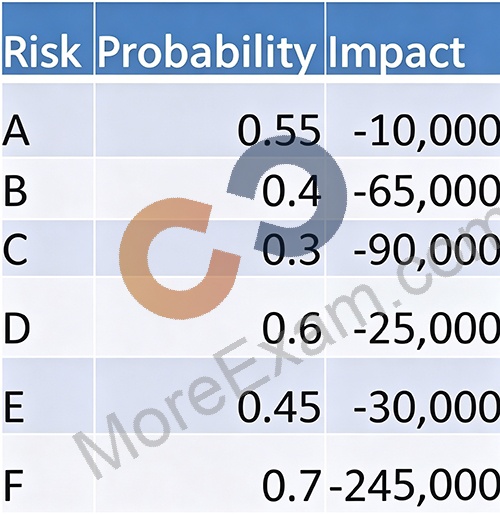
Question37: You are the project manager of the GHE Project. You have identified the following risks with the characteristics as shown in the following figure: How much capital should the project set aside for the risk contingency reserve?

Question38: During qualitative risk analysis you want to define the risk urgency assessment. All of the following are indicators of risk priority except for which one?

Question39: Joan is a project management consultant and she has been hired by a firm to help them identify risk events within the project. Joan would first like to examine the project documents including the plans, assumptions lists, project files, and contracts. What key thing will help Joan to discover risks within the review of the project documents?

Question40: You are the project manager of the HQQ Project for your company. You are working with your project stakeholders to discuss the risks in the project that can adversely affect the project objectives. You are discussing the possibilities of causes for an identified risk event in your project. Your stakeholder is confused on the difference between causes and risk events. Which of the following is NOT an example of a cause for a project risk?

Question41: Kelly is the project manager of the BHH project for her organization. She is completing the risk identification process for this portion of her project. Which one of the following is the only thing that the risk identification process will create for Kelly?

Question42: Sammy is the project manager for her organization. She would like to rate each risk based on its probability and affect on time, cost, and scope. Harry, a project team member, has never done this before and thinks Sammy is wrong to attempt this approach. Harry says that an accumulative risk score should be created, not three separate risk scores. Who is correct in this scenario?

Question43: You are the project manager for your organization. You are working with your key stakeholders in the qualitative risk analysis process. You understand that there is certain bias towards the risk events in the project that you need to address, manage, and ideally reduce. What solution does the PMBOK recommend to reduce the influence of bias during qualitative risk analysis?

Question44: Frank is a project team member in your project. Frank has been adding changes to the software interface for the software that your project is creating. Because Frank has been adding these features new risks have entered into the project. You elect that these additions should be removed from the project even if it takes extra time and money to remove the features. What are these riskladen features called?

Question45: SIMULATION
Fill in the blank with an appropriate phrase. The _________ is the risk or danger of an action or an event, a method or a (technical) process that still conceives these dangers even if all theoretically possible safety measures would be applied

Question46: You are the project manager of the GHY project for your organization. You are about to start the qualitative risk analysis process for the project and you need to determine the roles and responsibilities for conducting risk management. Where can you find this information?

Question47: You are the project manager for BlueWell Inc. You are reviewing the risk register for your project. The risk register provides much information to you, the project manager and to the project team during the risk response planning. All of the following are included in the risk register except for which item?

Question48: You are working as a project manager in your organization. You are nearing the final stages of project execution and looking towards the final risk monitoring and controlling activities. For your project archives, which one of the following is an output of risk monitoring and control?

Question49: Don is the project manager of the PFO project for his organization. Don is working with the project team members and two subject matter experts to assess the identified risk events in the project. Which of the following approaches is the best to assess the risk events in the project?

Question50: Your project team has identified a project risk that must be responded to. The risk has been recorded in the risk register and the project team has been discussing potential risk responses for the risk event. The event is not likely to happen for several months but the probability of the event is high. Which one of the following is a valid response to the identified risk event?

Question51: You are the project manager of the NGQQ Project for your company. To help you communicate project status to your stakeholders, you are going to create a stakeholder register. All of the following information should be included in the stakeholder register except for which one?

Question52: You work as a project manager for TechSoft Inc. You, the project team, and the key project stakeholders have completed a round of quantitative risk analysis. You now need to update the risk register with your findings so that you can communicate the risk results to the project stakeholders - including management.
You will need to update all of the following information except for which one?

Question53: You are the project manager for the TTR project. You are in the process of gathering information for risk identification. You ask experts to participate in the process through their emails for maintaining anonymity.
You collect the responses, summarize them, and are then re-circulated to the experts for further comment.
Which of the following techniques are you using for risk identification?

Question54: Henry is the project manager of the QBG Project for his company. This project has a budget of $4,576,900 and is expected to last 18 months to complete. The CIO, a stakeholder in the project, has introduced a scope change request for additional deliverables as part of the project work. What component of the change control system would review the proposed changes' impact on the features and functions of the project's product?

Question55: Thomas is the project manager of the NHJ Project for his company. He has identified several positive risk events within his project and he thinks these events can save the project time and money. Positive risk events, such as these within the NHJ Project are also known as what?

Question56: Which positive risk response best describes a teaming agreement?

Question57: Which types of project tends to have more well-understood risks?

Question58: You are the project manager of the GHG project for your company. You have identified the project risks, completed qualitative and quantitative analysis, and created risk responses. You also need to document how and when risk audits will be performed in the project. Where will you define the frequency of risk audits?

Question59: You and your project team have identified the project risks and now are analyzing the probability and impact of the risks. What type of analysis of the risks provides a quick and high-level review of each identified risk event?

Question60: Ruth is the project manager of ISFH project for her company. This project is forty percent complete and it appears that some risk events are going to happen in the project that will have an adverse affect on the project. Ruth creates a change request regarding the risks. Is this a valid response?

Question61: You are the project manager of the NKQ project for your organization. You have completed the quantitative risk analysis process for this portion of the project. What is the only output of the quantitative risk analysis process?

Question62: Yolanda is the project manager of a high-profile project for her organization. This project has 124 stakeholders from across the organization and many of the stakeholders have high demands and expectations for the project. Yolanda will need several pieces of project information as she begins to communicate and manage the stakeholder expectations. Which of the following inputs of the manage stakeholder expectations process directly addresses the risks that could affect the project and which must be communicated to the project stakeholders?

Question63: You are the project manager for your company and a new change request has been approved for your project. This change request, however, has introduced several new risks to the project. You have communicated these risk events and the project stakeholders understand the possible effects these risks could have on your project. You elect to create a mitigation response for the identified risk events. Where will you record the mitigation response?

Question64: You are the project manager of the NNH Project. In this project you have created a contingency response that the schedule performance index should be less than 0.93. The NHH Project has a budget at completion of $945,000 and is 45 percent complete though the project should be 49 percent complete. The project has spent $455,897 to reach the 45 percent complete milestone. What is the project's schedule performance index?

Question65: You are the project manager of the GYH project for your organization. Management has asked you to begin identifying risks and to use an information gathering technique. Which one of the following risk identification approaches is an information gathering technique?

Question66: Elizabeth is a project manager for her organization and she finds risk management to be very difficult for her to manage. She asks you, a lead project manager, at what stage in the project will risk management become easier. What answer best resolves the difficulty of risk management practices and the effort required?

Question67: Nancy is the project manager of a project with 78 stakeholders. This is a high-profile project and she needs to express to her project team and to the management the importance of communication in this project.
She would like to show the number of stakeholder communication channels in the project. Based on this information how many communication channels exist within this project?

Question68: You are working with your project stakeholders to identify risks within the JKP Project. You want to use an approach to engage the stakeholders to increase the breadth of the identified risks by including internally generated risk. Which risk identification approach is most suited for this goal?

Question69: Courtney is the project manager for her organization. She is working with the project team to complete the qualitative risk analysis for her project. During the analysis Courtney encourages the project team to begin the grouping of identified risks by common causes. What is the primary advantage to group risks by common causes during qualitative risk analysis?

Question70: Shawn is the project manager of the WHT Project for his company. In this project Shawn's team reports that they have found a way to complete the project work for less cost than what was originally planned.
The project team presents a new software that will help to automate the project work. While the software and the associated training costs $25,000 it will save the project nearly $65,000 in total costs. Shawn agrees to the software and changes to the project management plan accordingly. What type of risk response has been used in this instance?

Question71: You are the project manager of a large construction project. Part of the project involves the wiring of the electricity in the building your project is creating. You and the project team determine the electrical work is too dangerous to perform yourself so you hire an electrician to perform the work for the project. This is an example of what type of risk response?

Question72: Mary is the project manager of the HGH Project for her company. She and her project team have agreed that if the vendor is late by more than ten days they will cancel the order and hire the NBG Company to fulfill the order. The NBG Company can guarantee orders within three days, but the costs of their products are significantly more expensive than the current vendor. What type of a response strategy is this?

Question73: The Project Risk Management knowledge area focuses on which of the following processes? Each correct answer represents a complete solution. Choose all that apply.

Question74: You are interviewing members of a project team to test their understanding of the assigned risk responses as risk owners. You and the project manager are working together to evaluate the risk responses to determine their effectiveness in the project. What project management technique are you performing with the project manager in this scenario?

Question75: Stephen is the project manager of the GBB project. He has worked with two subject matter experts and his project team to complete the risk assessment technique. There are approximately 47 risks that have a low probability and a low impact on the project. Which of the following answers best describes what Stephen should do with these risk events?

Question76: John works as a project manager for ABD project. He and his team, are working on the following activities:
Relative ranking or priority list of project risks

Watchlists of low priority risk

Trends in Qualitative Risk Analysis results

On which of the following processes is John working on?

Question77: During which of the following processes, probability and impact matrix is prepared?

Question78: You work as a project manager for BlueWell Inc. You are preparing to plan risk responses for your project with your team. How many risk response types are available for a negative risk event in the project?

Question79: Your project uses a piece of equipment that if the temperature of the machine goes above 450 degree Fahrenheit the machine will overheat and have to be shut down for 48 hours. Should this machine overheat even once it will delay the project's end date. You work with your project to create a response that should the temperature of the machine reach 430, the machine will be paused for at least an hour to cool it down. The temperature of 430 is called what?

Question80: You are the project manager for GHY Project and are working to create a risk response for a negative risk.
You and the project team have identified the risk that the project may not complete on time, as required by the management, due to the creation of the user guide for the software you're creating. You have elected to hire an external writer in order to satisfy the requirements and to alleviate the risk event. What type of risk response have you elected to use in this instance?

Question81: Fred is the project manager of a large project in his organization. Fred needs to begin planning the risk management plan with the project team and key stakeholders. Which plan risk management process tool and technique should Fred use to plan risk management?

Question82: Virginia is the project manager for her organization. She has hired a subject matter expert to interview the project stakeholders on certain identified risks within the project. The subject matter expert will assess the risk event with what specific goal in mind?

Question83: Which one of the following is the only output for the qualitative risk analysis process?
Question84: There are four inputs to the Monitoring and Controlling Project Risks process. Which one of the following will NOT help you, the project manager, to prepare for risk monitoring and controlling?

Question85: You are the project manager for the NHQ Project. This project requires that you install 140 copies of design software onto your department's computers. The vendor offers you a twenty percent discount on the software if your company will purchase 150 or more copies of the software. You communicate this offer with other departments in your firm to see if anyone else would need 10 copies of the software to save your project a significant amount of funds. What is this risk response called?

Question86: You are the project manager of the GHY project for your company. This project has a budget of $543,000 and is expected to last 18 months. In this project, you have identified several risk events and created risk response plans. In what project management process group will you implement risk response plans?

Question87: Management has asked you to perform a risk audit and report back on the results. Bonny, a project team member asks you what a risk audit is. What do you tell Bonny?

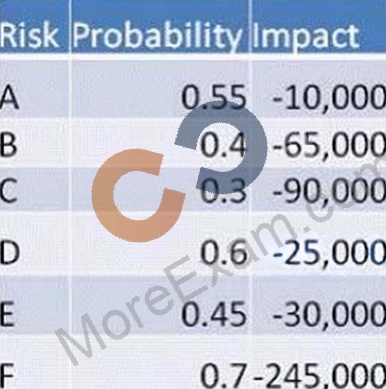
Question88: Consider the risk probability-impact matrix in the figure given below:

If Risk B happens in this project, how much will be left in the contingency reserve?

Question89: You work as a project manager for BlueWell Inc. You have to communicate the causes of risk events to the stakeholders. Which risk diagramming technique you will use to communicate the causes of risk events to project stakeholders?

Question90: You are the project manager of the GHG project. You are preparing for the quantitative risk analysis process. You are using organizational process assets to help you complete the quantitative risk analysis process. Which one of the following is NOT a valid reason to utilize organizational process assets as a part of the quantitative risk analysis process?

Question91: You work as a project manager for BlueWell Inc. You have declined a proposed change request because of the risk associated with the proposed change request. Where should the declined change request be documented and stored?

Question92: ____ analysis is a statistical concept that calculates the average outcome when the future includes scenarios that may or may not happen.

Question93: The only output of the perform qualitative risk analysis are risk register updates. When the project manager updates the risk register he will need to include several pieces of information including all of the following except for which one?

Question94: Tom works as a project manager for BlueWell Inc. He is determining which risks can affect the project.
Which of the following inputs of the identify risks process is useful in identifying risks, and provides a quantitative assessment of the likely cost to complete the scheduled activities?

Question95: You are the project manager for your organization. You have determined that an activity is too dangerous to complete internally so you hire licensed contractor to complete the work. The contractor, however, may not complete the assigned work on time which could cause delays in subsequent work beginning. This is an example of what type of risk event?

Question96: You are the project manager of the NHQ Project for your company. You have completed qualitative and quantitative analysis of your identified project risks and you would now like to find an approach to increase project opportunities and to reduce threats within the project. What project management process would best help you?

Question97: Joyce is the project manager for her company. Joyce and her project team are working through the quantitative analysis for certain risk events within her project. According to the enterprise environmental factors the project manager is to perform sensitivity analysis on any risk with an impact greater than $5,000 in the project. What is the sensitivity analysis?

Question98: You are the project manager of the NHJ project for your company. This project has a budget at completion of $1,650,000 and you are 60 percent complete. According to the project plan, however, the project should be 65 percent complete. In this project you have spent $995,000 to reach this point of completion. There is a risk that this project may be late so you have taken some measures to recover the project schedule.
Management would like to know, based on current performance, what the estimate at completion for this project will be. What is the estimate at completion?

Question99: Tom is the project manager for his organization. In his project he has recently finished the risk response planning. He tells his manager that he will now need to update the cost and schedule baselines. Why would the risk response planning cause Tom the need to update the cost and schedule baselines?

Question100: You and your project team are just starting the risk identification activities for a project that is scheduled to last for 18 months. Your project team has already identified a long list of risks that need to be analyzed.
How often should you and the project team do risk identification?

Question101: You are the project manager for BlueWell Inc. Your current project is a high priority and high profile project within your organization. You want to identify the project stakeholders that will have the most power in relation to their interest on your project. This will help you plan for project risks, stakeholder management, and ongoing communication with the key stakeholders in your project. In this process of stakeholder analysis, what type of a grid or model should you create based on these conditions?

Question102: There are seven risks responses that a project manager can choose from. Which risk response is appropriate for both positive and negative risk events?

Question103: You are a risk auditor for your company. You are reviewing the contract types a project manager has used in her project. Of the following, which contract type has the most risk for the project manager as a buyer?

Question104: Bill is the project manager of the JKH Project. He and the project team have identified a risk event in the project with a high probability of occurrence and the risk event has a high cost impact on the project. Bill discusses the risk event with Virginia, the primary project customer, and she decides that the requirements surrounding the risk event should be removed from the project. The removal of the requirements does affect the project scope, but it can release the project from the high risk exposure. What risk response has been enacted in this project?

Question105: Which of the following processes looks at the complex web of actors, rules, conventions, processes, and mechanisms concerned with how relevant risk information is collected, analyzed and communicated, and how management decisions are taken?

Question106: You are the project manager of the BlueStar project in your company. Your company is structured as a functional organization and you report to the functional manager that you are ready to move onto the qualitative risk analysis process. What will you need as inputs for the qualitative risk analysis of the project in this scenario?

Question107: Kelly is the project manager of the NNQ Project for her company. This project will last for one year and has a budget of $350,000. Kelly is working with her project team and subject matter experts to begin the risk response planning process. When the project manager begins the plan risk response process, what two inputs will she need?

Question108: Beth is a project team member on the JHG Project. Beth has added extra features to the project and this has introduced new risks to the project work. The project manager of the JHG project elects to remove the features Beth has added. The process of removing the extra features to remove the risks is called what?

Question109: Tom is the project manager of the GGG project for his company. He is working with the project team on the Perform Qualitative Risk Analysis process. Tom is having the project team to review the project scope statement as an input to the qualitative risk analysis process. Why?

Question110: Jeff, a key stakeholder in your project, wants to know how the risk exposure for the risk events is calculated during quantitative risk analysis. He is worried about the risk exposure which is too low for the events surrounding his project requirements. How is the risk exposure calculated?

Question111: Sensitivity analysis is a technique for systematically changing parameters in a model to determine the effects of such changes and is useful for computer modelers for a range of purposes. Which of the following purposes does the sensitivity analysis include? Each correct answer represents a complete solution. Choose all that apply.

Question112: Which of the following processes must be repeated after Plan Risk Responses, as well as part of the Monitor and Control Risks, to determine if the overall project risk has been satisfactorily decreased?

Question113: The risk transference is referred to the transfer of risks to a third party, usually for a fee, it creates a contractual-relationship for the third party to manage the risk on behalf of the performing organization.
Which one of the following is NOT an example of the transference risk response?

Question114: Fred is the project manager of the CPS project. He is working with his project team to prioritize the identified risks within the CPS project. He and the team are prioritizing risks for further analysis or action by assessing and combining the risks probability of occurrence and impact. What process is Fred completing?

Question115: You work as the project manager for BlueWell Inc. You are monitoring the project performance. You want to make a decision to change the project plan to eliminate a risk in order to protect the project objectives.
Which of the following strategies will you use to tackle the risk?

Question116: Jeff works as a project manager for BlueWell Inc. He is determining which risks can affect the project.
Which of the following are the inputs to the identify risks process that Jeff will use to accomplish the task?
Each correct answer represents a complete solution. Choose all that apply.

Question117: You are completing the qualitative risk analysis process with your project team and are relying on the risk management plan to help you determine the budget, schedule for risk management, and risk categories.
You discover that the risk categories have not been created. When should the risk categories have been created?

Question118: Your project spans the entire organization. You would like to assess the risk of the project but are worried that some of the managers involved in the project could affect the outcome of any risk identification meeting. Your worry is based on the fact that some employees would not want to publicly identify risk events that could make their supervisors look bad. You would like a method that would allow participants to anonymously identify risk events. What risk identification method could you use?

Question119: Ben works as a project manager for the MJH Project. In this project, Ben is preparing to identify stakeholders so he can communicate project requirements, status, and risks. Ben has elected to use a salience model as part of his stakeholder identification process. Which of the following activities best describes a salience model?

Question120: You are working with the project stakeholders to analyze and prioritize their requirements for the project.
One of the project requirements is to achieve a high-level of customer satisfaction for the project deliverable. What is the danger in this project requirement?

Question121: You are preparing to start the qualitative risk analysis process for your project. You will be relying on some organizational process assets to influence the process. Which one of the following is NOT a probable reason for relying on organizational process assets as an input for qualitative risk analysis?

Question122: You are the project manager of the YHG project for your company. Within the project, you and the project team have identified a risk event that could have a financial impact on the project of $450,000. This risk event has a 70 percent chance of occurring in the project. The project identifies a solution that will reduce the probability of the risk event to ten percent, but it will cost $260,000 to implement. Management agrees with the solution and asks that you include the risk response in the project plan. What risk response is this?

Question123: Which of the following processes involves choosing the alternative strategies, executing a contingency or fallback plan, taking corrective action, and modifying the project management plan?

Question124: Billy is the project manager of the HAR Project and is in month six of the project. The project is scheduled to last for 18 months. Management asks Billy how often the project team is participating in risk reassessment in this project. What should Billy tell management if he's following the best practices for risk management?

Question125: Where can a project manager find risk-rating rules?
Question126: Todd is the project manager of the EST project for his company. His organization has established certain rules in the enterprise environmental factors which affect the approach that Todd takes in managing his project. One of the rules requires Todd to consider the risk attitude of the stakeholders participating in risk analysis. Why must risk attitude be considered as a part of risk analysis?

Question127: You work as a project manager for BlueWell Inc. You are involved with the project team on the different risk issues in your project. You are using the applications of IRGC model to facilitate the understanding and managing the rising of the overall risks that have impacts on the economy and society. One of your team member wants to know that what is the need to use the IRGC. What will be your reply?

Question128: Pete works as a project manager for BlueWell Inc. The Management has told him that he must implement an agreed-upon contingency response if the cost performance index in his project is less than 0.90.
Consider that Pete's project has a budget at completion of $275,000. His project is 65 percent complete and he has spent $175,000 to date. However, Pete is scheduled to be 78 percent complete. What is the cost performance index for this project to determine if the contingency response should happen?

Question129: What project management plan is most likely to direct the quantitative risk analysis process for a project in a matrix environment?

Question130: Jenny is the project manager of the NHJ Project for her company. She has identified several positive risk events within the project and she thinks these events can save the project time and money. You, a new team member wants to know that how many risk responses are available for a positive risk event. What will Jenny reply to you?

Question131: Rex is the project manager of the BDF Project. This project will last for two years and has a budget of
$2,345,000. Management has instructed Rex that the project must not go over budget as funds are very tight in the organization. During the project planning Rex and the project team discover a positive risk event to save $75,000. Rex wants to make certain that this risk event happens so which risk response method is most appropriate?

Question132: Who is responsible for the stakeholder expectations management in a high-profile, high-risk project?

Question133: There are five outputs of the risk monitoring and controlling process. Which one of the following is NOT an output of the process?

Question134: You are the project manager of the KJH Project and are working with your project team to plan the risk responses. Consider that your project has a budget of $500,000 and is expected to last six months. Within the KJH Project you have identified a risk event that has a probability of .70 and has a cost impact of
$350,000. When it comes to creating a risk response for this event what is the risk exposure of the event that must be considered for the cost of the risk response?

Question135: You are the project manager of the HJH project for your company. In your project, you have created the probability-impact risk matrix as shown in the following figure:

If Risk D happens in this project, how much will be left in the contingency reserve?

Question136: You work as a project manager for SoftTech Inc. You have implemented the risk action plan and it was not effective. What type of plan should you as a project manager will create for implementation if a selected risk strategy fails to be fully effective?

Question137: You are the project manager of QSL project for your organization. You are working with your project team and several key stakeholders to create a diagram that shows how various elements of a system interrelate and the mechanism of causation within the system. What diagramming technique are you using as a part of the risk identification process?

Question138: You are the project manager of the NNH project. In this project you have created a contingency response that the cost performance index should be less than 0.93. The NHH project has a budget at completion of
$945,000 and is 45 percent complete - though the project should be 49 percent complete. The project has spent $455,897 to reach the 45 percent complete milestone. What is the project's cost performance index?

Question139: Which of the following processes is described in the statement below? "This is the process of numerically analyzing the effect of identified risks on overall project objectives."

Question140: What risk identification technique allows participants to identify the project risks and to remain anonymous?

Question141: Thomas is a key stakeholder in your project. Thomas has requested several changes to the project scope for the project you are managing. Upon review of the proposed changes, you have discovered that these new requirements are laden with risks and you recommend to the change control board that the changes be excluded from the project scope. The change control board agrees with you. What component of the change control system communicates the approval or denial of a proposed change request?

Question142: John works as a project manager for BlueWell Inc. He is determining which risks can affect the project.
Which of the following inputs of the identify risks process is useful in identifying risks associated to the time allowances for the activities or projects as a whole, with a width of the range indicating the degrees of risk?

Question143: Don has hired Jerry, a contractor, to complete a portion of his project work. The contract used was a cost- plus contract. If Don were to perform a risk audit, who would carry the risk in this scenario?

Question144: Risks with low ratings of probability and impact are included on a ____ for future monitoring.

Question145: You work as a project manager for BlueWell Inc. You are working with Nancy, the COO of your company, on several risks within the project. Nancy understands that through qualitative analysis you have identified
80 risks that have a low probability and low impact as the project is currently planned. Nancy's concern, however, is that the impact and probability of these risk events may change as conditions within the project may change. She would like to know where will you document and record these 80 risks that have low probability and low impact for future reference. What should you tell Nancy?

Question146: You work as a project manager for TechSoft Inc. You are working with the project stakeholders on the qualitative risk analysis process in your project. You have used all the tools to the qualitative risk analysis process in your project. Which of the following techniques is NOT used as a tool in qualitative risk analysis process?

Question147: Mary is the project manager of PKT project. In Mary's project there are certain enterprise environmental factors that require Mary to use modeling and simulation techniques to predict the likelihood of achieving cost and schedule objectives in the project. Mary is using a technique for which the cost estimates are chosen at random for each iteration of the analysis, such as pessimistic, most likely, and worst-case scenarios. What type of analysis is Mary using in this project?

Question148: Frank is the project manager of the NHH Project. He is working with the project team to create a plan to document the procedures to manage risks throughout the project. This document will define how risks will be identified and quantified. It will also define how contingency plans will be implemented by the project team. What document is Frank and the NHH Project team creating in this scenario?

Question149: Examine the figure given below.
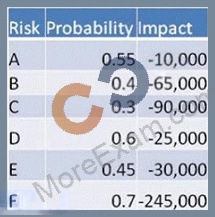
What will be the expected monetary value of Risk C?

Question150: You work as a project manager for BlueWell Inc. You are currently working with the project stakeholders to identify risks in your project. You understand that the qualitative risk assessment and analysis can reflect the attitude of the project team and other stakeholders to risk. Effective assessment of risk requires management of the risk attitudes of the participants. What should you, the project manager, do with assessment of identified risks in consideration of the attitude and bias of the participants towards the project risk?

Question151: Mark works as a project manager for TechSoft Inc. Mark, the project team, and the key project stakeholders have completed a round of qualitative risk analysis. He needs to update the risk register with his findings so that he can communicate the risk results to the project stakeholders - including management. Mark will need to update all of the following information except for which one?

Question152: You work as a project manager for BlueWell Inc. You are working with your team members on the risk responses in the project. Which risk response will likely cause a project to use the procurement processes?

Question153: In what portion of a project are risk and opportunities greatest and require intense planning and anticipation of risk events?

Question154: Gary is the project manager of the MMQ project for his company. He is working with his project team to plan the risk responses for his project. Sarah, a project team member, does not understand the process that Gary is using to plan the risk responses. Which approach is the preferred method to address project risks and the risk responses?

Question155: You work as a project manager for BlueWell Inc. You would like to utilize sensitivity analysis in your project, but the management does not understand how this will be displayed. What type of chart is usually used with sensitivity analysis to show the relative affect of risks on the project?

Question156: You work as a project manager for BlueWell Inc. Your project is using a new material to construct a large warehouse in your city. This new material is cheaper than traditional building materials, but it takes some time to learn how to use the material properly. You have communicated to the project stakeholders that you will be able to save costs by using the new material, but you will need a few extra weeks to complete training to use the materials. This risk response of learning how to use the new materials can also be known as what term?

Question157: You work as a project manager for TechSoft Inc. You are preparing to plan risk responses for your project with your project team. How many risk responses are available for a positive risk event in the project?

Question158: You are the project manager for your organization. You are working with your project team to complete the qualitative risk analysis process. The first tool and technique you are using requires that you assess the probability and what other characteristic of each identified risk in the project?

Question159: Which of the following documents is described in the statement below? "It is developed along with all processes of the risk management. It contains the results of the qualitative risk analysis, quantitative risk analysis, and risk response planning."

Question160: You are the project manager of the NNQ Project for your company and are working with your project team to define contingency plans for the risks within your project. Mary, one of your project team members, asks what a contingency plan is. Which of the following statements best defines what a contingency response is?

Question161: You are the project manager for your organization. You are preparing for the quantitative risk analysis.
Mark, a project team member, wants to know why you need to do quantitative risk analysis when you just completed qualitative risk analysis. Which one of the following statements best defines what quantitative risk analysis is?

Question162: Holly is the project manager of the NSS Project for her company. She is discussing some of the project risks and the issues that have happened in the project. Holly has faxed the status report to her project client for their review. Based on the standard communication model, which component in this scenario is the decoder?

Question163: Harry works as a project manager for BlueWell Inc. He is determining how to conduct the risk management activities for a project. According to the PMBOK, there are six inputs to the plan risk management process.
Which one of the following is NOT an input to this process?

Question164: Ted is the project manager of the HRR project for his company. Management has asked that Ted periodically reviews the contingency reserve as risk events happen, pass, or are still pending. What is the purpose of reviewing the contingency reserve?

Question165: Amy is the project manager for her company. In her current project the organization has a very low tolerance for risk events that will affect the project schedule. Management has asked Amy to consider the affect of all the risks on the project schedule. What approach can Amy take to create a bias against risks that will affect the schedule of the project?

Question166: What approach can a project manager use to improve the project's performance during qualitative risk analysis?

Question167: As a part of monitoring and controlling the project, the project manager should update the risk register. The project manager should update the risk register with information on risk reassessment, risk audits, and periodic risk reviews. What other information should the project manager update the risk register with?

Question168: You are the project manager of the GHY project. In your organization you must follow certain enterprise environmental factors that establish the rules for risk management . One of the policies your project must adhere to requires periodic rapid analysis of risks within the project. These rapid, cost-effective session must be documented and performed monthly. What type of analysis are you required to perform according to your enterprise environmental factors?

Question169: You work as a project manager for BlueWell Inc. You are working on a project and the management wants a rapid and cost-effective means for establishing priorities for planning risk responses in your project.
Which risk management process can satisfy management's objective for your project?

Question170: David is the project manager of HGF project for his company. David, the project team, and several key stakeholders have completed risk identification and are ready to move into qualitative risk analysis. Tracy, a project team member, does not understand why they need to complete qualitative risk analysis. Which one of the following is the best explanation for completing qualitative risk analysis?

Question171: Mark is the project manager of the BFL project for his organization. He and the project team are creating a probability and impact matrix using RAG rating. There is some confusion and disagreement among the project team as to how a certain risk is important and priority for attention should be managed. Where can Mark determine the priority of a risk given its probability and impact?

Question172: You are the project manager for a construction project. The project includes a work that involves very high financial risks. You decide to insure processes so that any ill happening can be compensated. Which type of strategies have you used to deal with the risks involved with that particular work?

Question173: Neil works as a project manager for SoftTech Inc. He is working with Tom, the COO of his company, on several risks within the project. Tom understands that through qualitative analysis Neil has identified many risks in the project. Tom's concern, however, is that the priority list of these risk events are sorted in "high- risk," "moderate-risk," and "low-risk" as conditions apply within the project. Tom wants to know that is there any other objective on which Neil can make the priority list for project risks. What will be Neil's reply to Tom?

Question174: You and your project team are identifying the risks that may exist within your project. Some of the risks are small risks that won't affect your project much if they happen. What should you do with these identified risk events?

Question175: You are the project manager for the NHH project. You are working with your project team to examine the project from four different defined perspectives to increase the breadth of identified risks by including internally generated risks. What risk identification approach are you using in this example?

Question176: SIMULATION
Fill in the blank with an appropriate phrase.
________is the study of how the variation (uncertainty) in the output of a mathematical model can be apportioned, qualitatively or quantitatively, to different sources of variation in the input of a model.

Question177: Bill is the project manager for a project that will last six months and has a budget of $580,000. In this project a high-risk has been identified with the new materials the project will be using. Bill would like to assign one person, Beth, to be responsible to monitor this risk. Bill assigns Beth the authority to respond to the risk event if it appears in the risk events that is likely to happen. In addition, Bill hires a consultant to work with Beth on this area of the project. In this instance, who is the risk response owner?

Question178: You work as a project manager for BlueWell Inc. Management has asked you to work with the key project stakeholder to analyze the risk events you have identified in the project. They would like you to analyze the project risks with a goal of improving the project's performance as a whole. What approach can you use to achieve the goal of improving the project's performance through risk analysis with your project stakeholders?

Question179: You work as a project manager for BlueWell Inc. Your project is running late and you must respond to the risk. Which risk response can you choose that will also cause you to update the human resource management plan?

Question180: Adrian is the project manager of the NHP Project. In her project there are several work packages that deal with electrical wiring. Rather than to manage the risk internally she has decided to hire a vendor to complete all work packages that deal with the electrical wiring. By removing the risk internally to a licensed electrician Adrian feels more comfortable with project team being safe. What type of risk response has Adrian used in this example?

Question181: You work as a project manager for BlueWell Inc. You are performing the quantitative risk analysis for your project. One of the project risks has a 50 percent probability of happening, and it will cost the project
$55,000 if the risk happens. What will be the expected monetary value of this risk event?

Question182: John is the project manager of the NHQ Project for his company. His project has 75 stakeholders, some of which are external to the organization. John needs to make certain that he communicates about risk in the most appropriate method for the external stakeholders. Which project management plan will be the best guide for John to communicate to the external stakeholders?

Question183: Harold is the project manager of a large project in his organization. He has been actively communicating and working with the project stakeholders. One of the outputs of the manage stakeholder expectations process can actually create new risk events for Harold's project. Which output of the manage stakeholder expectations process can create risks?

Question184: You are the project manager of the GGH Project in your company. Your company is structured as a functional organization and you report to the functional manager that you are ready to move onto the quantitative risk analysis process. What things will you need as inputs for the quantitative risk analysis of the project in this scenario?

Question185: Gary is the project manager for his organization. He is working with the project stakeholders on the project requirements and how risks may affect their project. One of the stakeholders is confused about what constitutes risks in the project. Which of the following is the most accurate definition of a project risk?

Question186: Rachel is the project manager of the KJH Project for her company. She needs a method to create a quick and simple approach to risk identification to communicate the project risk with the stakeholders. Which one of the following approaches to risk identification should Rachel choose to provide a quick and simple listing of the project risks?

Question187: Which of the following is a risk response planning technique associated with threats that seeks to reduce the probability of occurrence or impact of a risk to below an acceptable threshold?

Question188: Jenny is the project manager for the NBT projects. She is working with the project team and several subject matter experts to perform the quantitative risk analysis process. During this process she and the project team uncover several risks events that were not previously identified. What should Jenny do with these risk events?

Question189: Ned is the project manager of the HNN project for your company. Ned has asked you to help him complete some probability distributions for his project. What portion of the project will you most likely use for probability distributions?

Question190: You work as a project manager for BlueWell Inc. You with your team are using a method or a (technical) process that conceives the risks even if all theoretically possible safety measures would be applied. One of your team member wants to know that what is a residual risk. What will you reply to your team member?

Question191: Adrian is a project manager for a new project using a technology that has recently been released and there's relatively little information about the technology. Initial testing of the technology makes the use of it look promising, but there's still uncertainty as to the longevity and reliability of the technology. Adrian wants to consider the technology factors a risk for her project. Where should she document the risks associated with this technology so she can track the risk status and responses?

Question192: Marsha is the project manager of the NHQ Project. There's a risk that her project team has identified, which could cause the project to be late by more than a month. Marsha does not want this risk event to happen so she devises extra project activities to ensure that the risk event will not happen. The extra steps, however, will cost the project an additional $10,000. What type of risk response is this approach?

Question193: Fred is the project manager of the PKL project. He is working with his project team to complete the quantitative risk analysis process as a part of risk management planning. Fred understands that once the quantitative risk analysis process is complete, the process will need to be completed again in at least two other times in the project. When will the quantitative risk analysis process need to be repeated?

Question194: You are the project manager of the NHQ project for your company. You are working with your project team to complete a risk audit. A recent issue that your project team responded to, and management approved, was to increase the project schedule because there was risk surrounding the installation time of a new material. Your logic was that with the expanded schedule there would be time to complete the installation without affecting downstream project activities. What type of risk response is being audited in this scenario?

Question195: You are the project manager for a construction project. The project involves casting of a column in a very narrow space. Because of lack of space, casting it is highly dangerous. High technical skill will be required for casting that column. You decide to hire a local expert team for casting that column. Which of the following types of risk response are you following?

Question196: You are the program manager for your organization. Management is considering a new program but they are worried about the program risks that may affect the program success. You know that there are three positive risks responses and three negative risk responses that each risk can have. Management asks you which risk response would be most appropriate for a large risk event if they wanted to hire a third-party to own the risk event for the program. What risk event is most appropriate?

Question197: You are the project manager of the GHY Project for your company. You have completed the risk response planning with your project team. You now need to update the WBS. Why would the project manager need to update the WBS after the risk response planning process? Choose the best answer.

Question198: Linda is the project manager of the NAB Project. One of the risks her project team has identified is too dangerous for the project team to manage internally so she has hired a vendor to complete this portion of the project and to manage the identified risk. What risk response has Linda used in this instance?

Question199: Mark works as a project manager of the NNH project. In this project, he has created a contingency response that the cost performance index should be less than 0.91. The NHH project has a budget at completion of $950,000 and is 43 percent complete - though the project should be 50 percent complete.
The project has spent $470,897 to reach the 43 percent complete milestone. What is the project's cost performance index?

Question200: You are the project manager of a large construction project. This project will last for 18 months and will cost $750,000 to complete. You are working with your project team, experts, and stakeholders to identify risks within the project before the project work begins. Management wants to know why you have scheduled so many risk identification meetings throughout the project rather than just initially during the project planning. What is the best reason for the duplicate risk identification sessions?

Question201: Melody is the project manager for her organization. She has created a risk response to conduct more tests on the software her project is creating. The identified risk that prompted this response was that the software is mission-critical and must be flawless before it can be put into product. What type of a risk response has Melody used in this scenario?

Question202: Mary is a project manager in her organization. On her current project she is working with her project team and other key stakeholders to identify the risks within the project. She is currently aiming to create a comprehensive list of project risks so she is using a facilitator to help generate ideas about project risks.
What risk identification method is Mary likely using?

Question203: You work as a project manager for BlueWell Inc. You want to create a visual diagram, which can depict the resources that will be used within the project. Which of the following diagrams will you create to accomplish the task?

Question204: Jane is the project manager of the GBB project for her company. In the current project a vendor has offered the project a ten percent discount based if they will order 100 units for the project. It is possible that the GBB Project may need the 100 units, but the cost of the units is not a top priority for the project. Jane documents the offer and tells the vendor that they will keep the offer in mind and continue with the project as planned. What risk response has been given in this project?

Question205: There are five inputs to the quantitative risk analysis process. Which one of the following is NOT an input to the perform quantitative risk analysis process?

Question206: You are the project manager of a large, high-profile project in your organization. You have realized that politics within your company may affect the true identification of risk events within the project. You decide that you'd like to use a method to identify risk events through an anonymous process. Which one of the following risk events will allow you to collect and distribute risk information without the stakeholders knowing what other stakeholders are communicating about the project risk events?

Question207: Your organization, as part of its enterprise environmental factors, has established risk governance to be implemented in each project. Part of this governance is the reassessment of risks within each project. How much detail and repetition in approach for risks to be reassessed for probability and impact?

Question208: Sensitivity analysis is a technique for systematically changing parameters in a model to determine the effects of such changes and is useful for computer modelers for a range of purposes. Which of the following purposes does the sensitivity analysis include? Each correct answer represents a complete solution. Choose all that apply.

Question209: You are the project manager of the GHY Project for your company. You need to complete a project management process that will be on the lookout for new risks, changing risks, and risks that are now outdated. Which project management process is responsible for these actions?

Question210: There are seven risk responses for any project. Which one of the following is a valid risk response for a negative risk event?

Question211: You work as a project manager for SoftTech Inc. You are working with the project stakeholders to begin the qualitative risk analysis process. Which of the following inputs will be needed for the qualitative risk analysis process in your project? Each correct answer represents a complete solution. Choose all that apply.

Question212: You are the project manager of the CUL project in your organization. You and the project team are assessing the risk events and creating a probability and impact matrix for the identified risks. Which one of the following statements best describes the requirements for the data type used in qualitative risk analysis?

Question213: Holly is the project manager of the GHH Project. During risk identification and the subsequent risk analysis process she has identified a risk with a high probability and high impact for her project. She and the stakeholder agree that the project management plan should be changed to eliminate the risk threat entirely. What risk response has Holly used in this instance?

Question214: Lisa is the project manager of the SQL project for her company. She has completed the risk response planning with her project team and is now ready to update the risk register to reflect the risk response.
Which of the following statements best describes the level of detail Lisa should include with the risk responses she has created?

Question215: You are the project manager of a large construction project. You are evaluating the strengths, weaknesses, opportunities, and threats involved in a project. In which of the following processes are you on?

Question216: Which of the following risk responses delineates that the project plan will not be changed to deal with the risk?

Question217: Shelly is the project manager of the BUF project for her company. In this project Shelly needs to establish some rules to reduce the influence of risk bias during the qualitative risk analysis process. What method can Shelly take to best reduce the influence of risk bias?

Question218: You are the project manager of a new project in your organization. You and the project team have identified the project risks, completed risk analysis, and are planning the most appropriate risk responses.
Which of the following tools is most effective to choose the most appropriate risk response?

Question219: You are the project manager for the ABC organization. Your current project has 75 internal stakeholders and 245 external stakeholders. Many of the risks within your project will only affect the internal stakeholders, but several of the identified risk events will affect the external stakeholders. Management would like to know the total number of communication channels in the project. How many communication channels exist in this project?

Question220: Adrian is a project manager for a new project using a technology that has recently been released and there's relatively little information about the technology. Initial testing of the technology makes the use of it look promising, but there's still uncertainty as to the longevity and reliability of the technology. Adrian wants to consider the technology factors a risk for her project. Where should she document the risks associated with this technology so she can track the risk status and responses?

Question221: You are the project manager for your organization and you are working with Thomas, a project team member. You and Thomas have been working on a specific risk response for a probable risk event in the project. Thomas is empowered with a risk response and will control all aspects of the identified risk response in which a particular risk event will happen within the project. What title, in regard to risk, is bestowed on Thomas?

Question222: You are the project manager of the AFD project for your company. You are working with the project team to reassess existing risk events and to identify risk events that have not happened and whose relevancy to the project has passed. What should you do with these events that have not happened and would not happen now in the project?

Question223: You are the project manager of the NHK Project. Management wants to know how often your risk identification process will occur during the project. Considering that your project is scheduled to last one year and involvs five distinct phases, how often should risk identification take place?

Question224: In addition to monitoring and controlling the project risks for their status and information the risk monitoring and controlling process accomplishes four key things for a project. Which one of the following is NOT a determination that is made by the risk monitoring and controlling process?

Question225: Consider a project with a budget at completion of $1,345,000 and it is supposed to be completed by today, but it is only 80 percent complete. This project has spent $1,250,000 to reach this point of completion.
What is the schedule variance for this project?

Question226: You are the project manager for TTP project. You are in the Identify Risks process. You have to create the risk register. Which of the following are included in the risk register? Each correct answer represents a complete solution. Choose two.

Question227: You work as the project manager for Bluewell Inc. You are working on NGQQ Projectyou're your company.
You have completed the risk analysis processes for the risk events. You and the project team have created risk responses for most of the identified project risks. Which of the following risk response planning techniques will you use to shift the impact of a threat to a third party, together with the responses?

Question228: You work as a project manager for BlueWell Inc. You are about to complete the quantitative risk analysis process for your project. You can use three available tools and techniques to complete this process. Which one of the following is NOT a tool or technique that is appropriate for the quantitative risk analysis process?

Question229: You work as a project manager for SoftTech Inc. You are working with the project stakeholders to begin the qualitative risk analysis process. You will need all of the following as inputs to the qualitative risk analysis process except for which one?

Question230: Frances is the project manager of a project in her organization. This project has a budget of $567,000 and is schedule to last for three years. Frances wants to examine the risk events to determine which risk events have the most potential impact on the project. Which modeling technique can help Frances to accomplish this goal?

Question231: Your project is an agricultural-based project that deals with plant irrigation systems. You have discovered a byproduct in your project that your organization could use to make a profit. If your organization seizes this opportunity it would be an example of what risk response?

Question232: A project manager must have certain interpersonal skills to communicate with stakeholders and manage their expectations of the project work. Which of the following interpersonal skills has been identified as one of the biggest reasons for project success or failure?

Question233: Joan is the project manager of the BTT project for her company. She has worked with her project to create risk responses for both positive and negative risk events within the project. As a result of this process Joan needs to update the project document updates. She has updated the assumptions log as a result of the findings and risk responses, but what other documentation will need to be updated as an output of risk response planning?

Question234: Della works as a project manager for Tech Perfect Inc. She is studying the documentation of planning of a project. The documentation states that there are twenty-eight stakeholders with the project. What will be the number of communication channels for the project?

Question235: SIMULATION
Fill in the blank with an appropriate phrase.
________are activities that are dangerous to complete and manage such as construction, electrical work, or manufacturing.

Question236: There are seven risk responses, a project manager can use to address risk events. Which one of the following is a risk response that is appropriate for positive or negative risk events depending on the scenario in the project?

Question237: You are the project manager of the NKJ Project for your company. The project's success or failure will have a significant impact on your organization's profitability for the coming year. Management has asked you to identify the risk events and communicate the event's probability and impact as early as possible in the project. Management wants to avoid risk events and needs to analyze the cost-benefits of each risk event in this project. What term is assigned to the low-level of stakeholder tolerance in this project?

Question238: Wendy is about to perform qualitative risk analysis on the identified risks within her project. Which one of the following will NOT help Wendy to perform this project management activity?

Question239: You are preparing to complete the quantitative risk analysis process with your project team and several subject matter experts. You gather the necessary inputs including the project's cost management plan.
Why is it necessary to include the project's cost management plan in the preparation for the quantitative risk analysis process?

Question240: Ben is the project manager of the YHT Project for his company. Alice, one of his team members, is confused about when project risks will happen in the project. Which one of the following statements is the most accurate about when project risk happens?

Question241: Which risk response is acceptable for both positive and negative risk events?
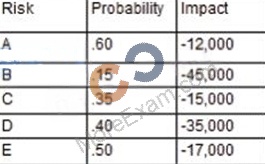
Question242: You are the project manager of the NHH Project for your company and you have completed the risk analysis processes for the risk events. You and the project team have created risk responses for most of the identified project risks. Now, you would like to assign risk owners to the events. Which risk events should have risk response owners?

Question243: You are the project manager of the GGK project for your company. The GGK project has a budget of
$1,265,100 and is currently 40 percent complete. In this project, you elected to add labor to the project to increase the likelihood of completing the project early as the project was only scheduled to be 35 percent complete at this time. This positive risk response, while keeping the project ahead of schedule, has added significant costs to the project. You have already spent $575,000 to reach this point in the project.
Management would like to know what your cost performance index and the schedule performance index is for this project. What are these values?

Question244: Donna is the project manager of the QSD Project and she believes Risk Event D in the following figure is likely to happen.

If this event does happen, how much will Donna have left in the risk contingency reserve if none of the other risk events have happened?

Question245: Holly is the project manager of the NHQ project for her company. Her project sponsor, Tracy, has requested that Thomas, the department manager, from the Risk Management Department, will work with Holly to determine the effectiveness of the risk responses. Tracy and Thomas are concerned that some of the risks within Holly's project may not be addressed to depth they would like. In this scenario, who is responsible for ensuring that risk audits are performed at an appropriate frequency throughout the project?

Question246: Which of the following diagrams displays sensitivity analysis data?
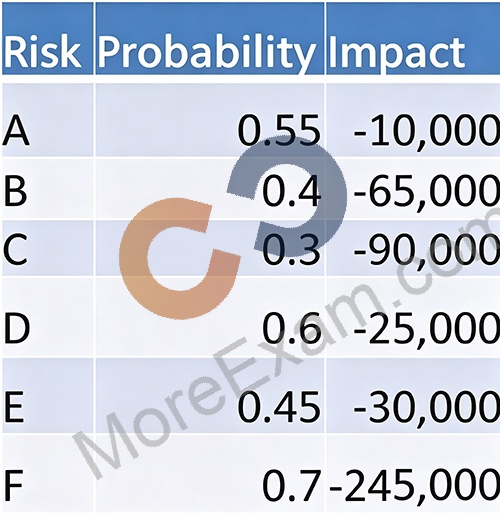
Question247: You are working with Anna on your project to determine and map the probability distributions of risk within the project. You have indicated that you will use the uniform distribution method for a portion of the project.
Which part of your project is most likely to have a uniform risk distribution?

Question248: Diana is the project manager of the QPS project for her company. In this project Diana and the project team have identified a pure risk. Diana and the project team decided, along with the key stakeholders, to remove the pure risk from the project by changing the project plan altogether. What is a pure risk?

Question249: The Identify Risk process determines the risks that affect the project and document their characteristics.
Why should the project team members be involved in the Identify Risk process?

Question250: Ben is the project manager of the CMH Project for his organization. He has identified a risk that has a low probability of happening, but the impact of the risk event could save the project and the organization with a significant amount of capital. Ben assigns Laura to the risk event and instructs her to research the time, cost, and method to improve the probability of the positive risk event. Ben then communicates the risk event and response to management. What risk response has been used here?

Question251: Wendy is the project manager of the NNJ project for her company. As part of the variance and trend analysis tool and technique for risk governance she is using earned value management. In this approach, Wendy wants to track and compare the cost and schedule variances. What is the point of this tool and technique in regard to risk?

Question252: Gary has identified a project risk that could injure project team members. He does not want to accept any risk where someone could become injured on this project so he hires a professional vendor to complete this portion of the project work. This workaround to the risk event is known as what type of risk response?

Question253: You are the project manager of the NHH project for your company. You have completed the first round of risk management planning and have created four outputs of the risk response planning process. Which one of the following is NOT an output of the risk response planning?

Question254: You are the project manager of the GHQ project for your company. You are working with your project team to prepare for the qualitative risk analysis process. Mary, a project team member, does not understand why you need to complete qualitative risks analysis. You explain to Mary that qualitative risks analysis helps you determine which risks needs additional analysis. There are also some other benefits that qualitative risks analysis can do for the project. Which one of the following is NOT an accomplishment of the qualitative risk analysis process?

Question255: Tracy is the project manager of the NLT Project for her company. The NLT Project is scheduled to last 14 months and has a budget at completion of $4,555,000. Tracy's organization will receive a bonus of
$80,000 per day that the project is completed early up to $800,000. Tracy realizes that there are several opportunities within the project to save on time by crashing the project work. Crashing the project is what type of risk response?

Question256: You work as the project manager for Bluewell Inc. There has been a delay in your project work that is adversely affecting the project schedule. You decide, with your stakeholders' approval, to fast track the project work to get the project done faster. When you fast track the project, what is likely to increase?

Question257: Which of the following components ensures that risks are examined for all new proposed change requests in the change control system?

Question258: You are the project manager of the GGG project. You have completed the risk identification process for the initial phases of your project. As you begin to document the risk events in the risk register what additional information can you associate with the identified risk events?

Question259: You work as the project manager for Bluewell Inc. Your project has several risks that will affect several stakeholder requirements. Which project management plan will define who will be available to share information on the project risks?

Question260: Your organization has named you the project manager of the JKN Project. This project has a BAC of
$1,500,000 and it is expected to last 18 months. Management has agreed that if the schedule baseline has a variance of more than five percent then you will need to crash the project. What happens when the project manager crashes a project?

Question261: You are the project manager of the GHY project for your organization. You are working with your project team to begin identifying risks for the project. As part of your preparation for identifying the risks within the project you will need eleven inputs for the process. Which one of the following is NOT an input to the risk identification process?

Question262: A high-profile, high-priority project within your organization is being created. Management wants you to pay special attention to the project risks and do all that you can to ensure that all of the risks are identified early in the project. Management has to ensure that this project succeeds. Management's risk aversion in this project is associated with what term?

Question263: Joan is the project manager of the KYU project for her company. She is working with management on defining a contingency reserve for her project. Currently the project is scheduled to last 18 months and it has a cost budget of $2.5 million. What two areas of the project can the contingency reserve address in regard to risk management?

Question264: David is the project manager of the NKL Project for his organization. He has been asked to create a proposal for a construction project for a client. David realizes that there are several requirements within the SOW and RFP provided by the client that would eliminate his company from bidding on the construction project. David proposed to management that his organization create a partnership with a competitor so that together they could bid on the construction project and qualify for the customer's requirements. What risk response is David proposing to management?

Question265: You are the project manager of the NHH project for your company. You and the project team have completed the quantitative risk analysis for your project. During this process you create a contingency reserve based on the risk probability-impact matrix as seen in the figure below.

Based on the information in the figure above, what amount would you need to include in your risk contingency fund?

Question266: Mary is the project manager for the BLB project. She has instructed the project team to assemble, to review the risks. She has included the schedule management plan as an input for the quantitative risk analysis process. Why is the schedule management plan needed for quantitative risk analysis?

Question267: You are the project manager of the AMD project for your organization. In this project, you are currently performing quantitative risk analysis. The tool and technique you are using is simulation where the project model is computed many times with the input values chosen at random for each iteration. The goal is to create a probability distribution from the iterations for the project schedule. What technique will you use with this simulation?

Question268: You are the project manager for Genpact Inc. You have established quarterly risk management meetings.
Which of the following is not a component of a risk management meeting?

Question269: Your organization has a project that is expected to last 20 months but the customer would really like the project completed in 18 months. You have worked on similar projects in the past and believe that you could fast track the project and reach the 18 month deadline. What increases when you fast track a project?

Question270: Your project has several risks that may cause serious financial impact should they happen. You have studied the risk events and made some potential risk responses for the risk events but management wants you to do more. They'd like for you to create some type of a chart that identified the risk probability and impact with a financial amount for each risk event. What is the likely outcome of creating this type of chart?

Question271: You are the project manager of your organization. Your organization will receive a bonus if the project finishes by December 20. Management has communicated this bonus to you and your project team and has asked you to evaluate the project to see if it is possible to realize the reward. The bonus offered to your organization is $750,000. You have examined the project and believe that you can crash the project for an additional $275,000 and reach the December 20 date. Management is thrilled with your assessment and they approve the crash fee. What risk response is this?

Question272: Rob is the project manager of the IDLK Project for his company. This project has a budget of $5,600,000 and is expected to last 18 months. Rob has learned that a new law may affect how the project is allowed to proceed - even though the organization has already invested over $750,000 in the project. What risk response is the most appropriate for this instance?